

To Exist in Exile

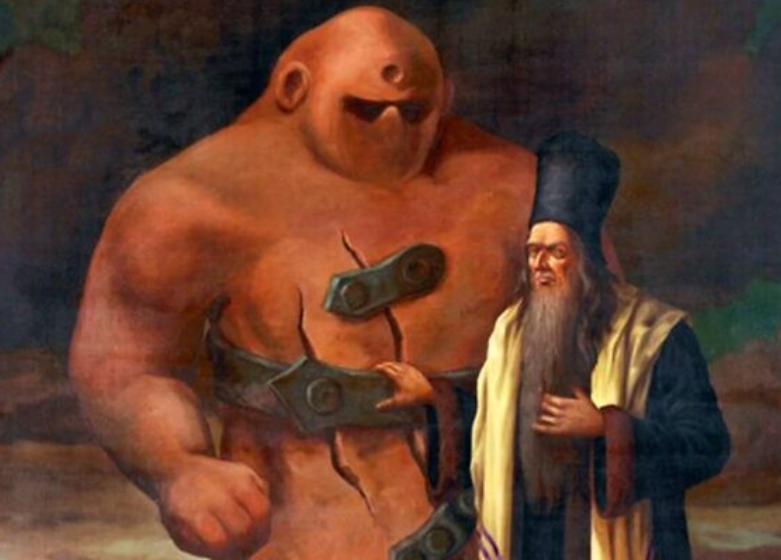
The great Maharal, Rabbi Yehuda Loeb of Prague, of the 16th century, is a fascinating character, generally and also in our context of messianism.
While Abarvanel, also a great and fascinating case, lived into the beginning of the 16th century, he was still very much a man of the 15th century.
Abarvanel summarized and symbolically sealed the medieval era. His heart and mind were in Spain and set on the expulsion and its immediate aftermath.
On the other hand, the Maharal, was from central Europe, he was born and died all in the 16th century. He did not experience first hand the expulsion from Spain...
The Maharal's life and circumstances were the beginning of the modern period. He witnessed first hand the Christian reformation and related circumstances. And persecution was somehow tolerable.
What was his program in religious leadership for the Jewish people, by deep conviction and zealous ideology? What was his style of writing? What did he say in regards to messianism?
Writing Aspects
The Maharal lived and studied and served and wrote in Moravia and Bohemia. He was excellent in all forms of rabbinic knowledge, including halacha, commentary, worldview, and more.
He was also knowledgeable in philosophy and Christianity - but he was hardly a philosopher nor an apologist. His focus was inwards, into Jewish community, lifestyle, thought, and religious education.
The Maharal wrote only at the later stages of his life. He wrote extensively in multiple fields. His major work on messianism is named Netzach Yisrael, which is a name of G-d in the Bible, translating directly as - the eternal one, or the eternity, or eternal, of Israel.
But it can mean the eternal nature of the people of Israel, or the strength of Israel, essentially. It is of the same root as the word nitzachon, which means victory, so it means the eternal aspects of Israel, and the victorious destiny of Israel, victory through its eternal nature.
The different works of the Maharal are associated with different holy days. This work is associated with the 9th of Av, marking the destruction of the Temple.
The connection is obvious between the Temple and Exile, to the Redemption and Messiah. The destruction of the Temple is a recurring theme in the book, but secondary to the main theme, which is messianism. But he approaches it from several directions…
His style of writing is challenging. It does not read in the form of systematic thinking and a clear structure of ideas. Though he is considered one who generated a system of ideas, it does not read like systematic thinking!
There are 63 chapters in the book. Some are short, some are very long. There are no titles. No consistent manner of communication. It seems quite associative. From chapter to chapter, even from paragraph to paragraph, he might switch from presenting and explaining a Talmudic source, and then switch to discussing a topic, back and forth.
Presumably, he is a master of writing, and knows what he wants to say, and uses this form of writing knowingly, with intent. His writing seems somewhat evasive, but we notice recurring principles and heed them.
The worldview he presents is based on metaphysical principles and logic, that he repeatedly addresses, through the length of the book.
These are apparently drawn from Jewish mysticism, and often he comments that there is more to be understood on this and that point, and this is apparently a reference to such Kabbalistic knowledge…

Also evident and prominent in the Maharal's worldview is treating the knowledge of the Sages as preeminent. He sees the rabbinic sources, Talmud and Midrash, as canonical prophetic literature. The Maharal utilizes this knowledge methodically, authoritatively, and in accord with his metaphysical principles.
Incidentally, in regards to the knowledge of the Sages and messianism, in the famous polemical “Disputation of Barcelona” with Pablo Christiani, Nachmanides throws off the arguments of his opponent by stating that non halachic sources are not fundamental grounds for Judaism faith categories, generally and more specifically for messianic beliefs.
Then it was Abarbanel actually, who took a major step in bringing Talmud and Midrash back to messianic prophetic fundamental grounds, as he devotes one out of three of messianic trilogy writings to interpretation of these sources.
But the Maharal takes it much further, relying on Talmud and Midrash as the primary authoritative knowledge for messianic beliefs.
[Incidentally, the approach of the Maharal indirectly referencing mystical knowledge is close to that of Nachmanides. And he writes about Nachmanides with utmost esteem, acknowledging him as an influence and holy man. But notably disagrees with Nachamnides on certain points.]
Apocalyptic Rejection
Though never explicitly mentioning him, the work of the Maharal on messianism is an antithesis to that of Abarbanel.
Abarbanel produced an extensive sophisticated apocalyptic presentation of messianism, including particular calculations as to when messianic redemption will take place.
The Maharal’s system distinctly, repeatedly, consistently - debunks the entire approach of apocalyptic messianic calculation. It is all a mistake, a misinterpretation, a fallacy. And he explains why, with multiple explanations and reinterpretations of sources.
For example, one of the major passages is the application of the 4 kingdoms in the messianic prophecy of Daniel. The Maharal agrees that these are messianic.
However, instead of projecting each animal representing a kingdom onto a real historical kingdom, the Maharal says they represent metaphysical strongholds of evil and opposition to the divine order and people of G-d.
The final and fourth kingdom, it is written by the Sages, will continue all the way to the messianic era. This is to say, according to the Maharal, a human evil form of political military hatred towards Israel, this is beyond human reason and reach, and it will last until G-d Himself intervenes and the world to come manifests.
The implication of this insight, of the Maharal, is a deterministic position, negated to apocalyptic calculations. You cannot calculate what does not possess a historical category. His metaphysical deterministic approach is antithetical to apocalypticism and historicism.
Measuring the Nations
For Abarbanel, the predicament of exile was a tragedy. It was a transgression. It was evil and not from G-d. It was to be reversed. That G-d and Israel would collaborate righteously to overcome the evil kingdoms of this world, and overcome subjugation to foreign nations, and make them subjugated to Israel…

For the Maharal, subjugation to foreign nations is against the essence of the Divine order of creation. In the messianic age, Israel will not be subjugated, nor will the other nations be subjugated to foreign dominion.
Each nation is given a plot of land, a language, and an essence. When nations are dispersed, or one nation infiltrates another, it is contrary to G-d’s divine order and His plan of creation extended. G-d created man, then woman, and so on.
Then there was the first nation Israel (not chronologically historically) and then the many nations, which are of a different category. The nations are an extension of the one original nation Israel - they are the Tower of Babel, nations dispersed by G-d throughout the earth.
Creation begins with the core, and with one, He is One, and then becomes plural. He is the creator, He is One, what He created is an extension that is relative to and will return to Him.
The Nations through the Nation will embrace the knowledge of the One. This is all a metaphysical divine order and plan. But it is not a linear history. Divine history is the medium of the nations and Israel drawing back in form to the Creator.
All these contrasts in the world create points of tension that shift things in the world and move history dialectically. So is the contrast between spiritual and material, Israel and the nations, oneness and plurality.
Spiritual Essence
The Maharal interprets and applies the sources according to this metaphysical theological view.
Exile is indeed because of Israel’s sins, to a certain degree, but that is not the real picture. It is more a matter of Israel wrestling with its calling, as a spiritual nation, to be differentiated from the nations, from worldly things of material essence.
Israel’s essence is spiritual form, as opposed to material. The Nations are essentially more material and less spiritual. Because of Israel’s spiritual nature, essence, and calling, it is inclined to weakness on the material side.
This is Jacob versus Esau, Esau trading his birthright for food is a symbol of spiritual versus material. Esau’s arms and voice are more animalistic, Jacob uses animal skins to make Isaac think he is Esau. Animals are a lower category of material and form.

Israel is cast among the nations, exiled, dispersed. It is weak on the side of the material, and weak in political power. The nations are strong in material political power. Israel must focus internally, on unity within its communities, on virtues and truths, which are Torah.
The removal of the land from the equation of the people, challenges Israel to maintain its unity or oneness. Land and language typically constitute a peoplehood but Israel, as a spiritual nation, maintains itself without the land.
Thus the scattering of Israel, the humiliation of subjugation, even though it is greater, is not a sign of its weakness but of its spiritual calling, as oneness is maintained.
This is the biblical story of the 12 spies of the 12 tribes of Israel scouting the land of Israel as it wandered out the wilderness from Egypt before entering the land. The 10 look at the material and think at a lower level of development and spiritual truth, but the 2 see as they should. This is the plight of Israel, to be like the 2 and not the 10.
So the exile of Israel is because of sin, but sin is not the story. The spiritual development of Israel is the real meaning.
G-d can not and will not abandon Israel. That is a logical fallacy. It is against G-d’s nature, against the divine order He created. Israel is the spiritual nation among creation, and that cannot just be altered or abandoned.
Naturally, the Maharal references the famous 3 oaths in tradition - playing off the verse in Song of Songs, to the daughters of Jerusalem, to avoid awakening love until the right time: these are all directives to accept the divine fate of exile until He ends it.
G-d ordered this exile. Its end can only come from Him. Israel must not cave into strife, nor apocalypticism, nor assimilation, nor resettling in some other land. Why reverse G-d's program?
At one point in the book he goes as far as pointing out that in the Bible, Israel is associated symbolically with sacrificial animals - bulls, goats, lambs. On the contrary, the nations are symbolized in the by predators of the sacrificial animals.
Sacrifice in Hebrew means that which is brought close (to G-d). So it is written that G-d seeks those who are persecuted. That is the meaning of Israel’s calling, to draw close to G-d, including the consequences of exile.
The Maharal cites the Talmudic story of Rabbi Akiva laughing with joy as they approach the ruins of the Temple and foxes come out of it, a sign of its desolation. The others question him in shock, why he laughs while they weep?
Akiva answers that because the one prophecy of destruction is fulfilled, that means that surely another prophecy will be fulfilled of greater joy and glory one day. And they are comforted.
Such principles construe a Jewish existentialism in the Diaspora. There is great meaning to being Jewish, maintaining the community, investing in spiritual depth. It is a great and very deep mission, quite the opposite of guilt, humiliation, and reason to rebel.
Contextually, these touch at two aspects of the predicament of Israel, two arguments - one is with Abarbanel, who directed an apocalyptic movement, and towards Christianity, whose central argument was that the Jewish existence among them is a testimony to the historical value of the New Testament and a sign of their sinful nature, punishment and rejection.
The Maharal's worldview flips the views of Abarbanel and of Christianity. It is anti-apocalyptic, non-historical, deterministic and religious existential.
Worlds Apart
Netzach Yisrael does not address the messianic prophecies in the same way as previous commentators, including Nachmanides and Abarbanel and others.
Rather, the messiah and messianic prophecies and interpretations in the Talmud and Midrash sources fit into his programmatic metaphysical narrative.
The identity of the Messiah is secondary to the main thrust, which is the metaphysical program. In this sense, the Maharal indeed creates a messianism more than a messianic idea! It is a spiritual or metaphysical framework which incorporates traditional messianic terminology but adapts their meaning to the overall framework.
The essence of the Messiah was established before creation, because it is of eternal nature, meaning it pertains to the divine metaphysical order. It means the primordial creative essence
The names of the Messiah that the various Sages teach, names that are associated with themselves or their schools, shows us that the Messiah is exceedingly excellent and carries all these attributes and virtues. All will find the values they appreciate within him, because he is all these things.
The messiah among the lepers in the Midrash teaches us that the Messiah is entirely other than human nature as we know it, set apart categorically. Riding on the donkey (Zechariah 9) or upon the clouds (Daniel 7) mean the same thing, that the Messiah is form and not material, in sharp contrast and clear imagery.

The messianic era (ימות המשיח) is differentiated from the world to come (עולם הבא). The world to come is beyond history, and it involves cosmological transformation, but this is beyond human understanding, and is entirely by G-d.
The messianic era is the most advanced stage of this world and laws of nature. The earth will yield crops abundantly. Mankind will not suffer as much. The nations will not subjugate each other, as their lust for dominance will alleviate, upon seeing Israel and following its lead of being. There will be peace and there will be devotion and enlightenment towards the One, on that day.
There is no use in predicting the timeline. The ages and preceding events of biblical prophecy or symbolic. The total of 7 is typological, it is the peak, before the stage of completion, which is 8.
Many such prophecies show us the contrast of what Messiah and messianic constitutes. The contrast, the lack, the negative, precedes that which is to come. Warfare in contrast to and preceding peace. Scorn, obstinance, immorality, degradation of knowledge and truth, in contrast to what constitutes what is messianic.
Gog and Magog are a symbol of the nations rising against the Messiah, because they lust for dominance and oppression, and the messianic redemption means the end of that aspect.
They rise against David, against the Kingdom of David, which is the political entity and leadership of Israel, who lead the knowledge of G-d in this world.
Messianic birthpangs mean that something new is coming, new life, it is the contrast of suffering before new life comes into being - manifestation of the messianic era, the messianic kingdom of Israel, the people of G-d, the One.
In summary, this perusal of messianism in the worldview of the Maharal, engages with much of the same sources from the classic rabbinical literature, but in an original and intriguing manner.
The way he engages with classic Christian arguments against Jewish existence is fascinating, as is the way he throws off the entire apocalyptic approach of the great Abarbanel.
Finally, the worldview of the Maharal is important to keep in mind as he was a significant influence on the Alter Rebbe the founder of Chabad, and directly and indirectly on Rabbi Kook.



Comments